

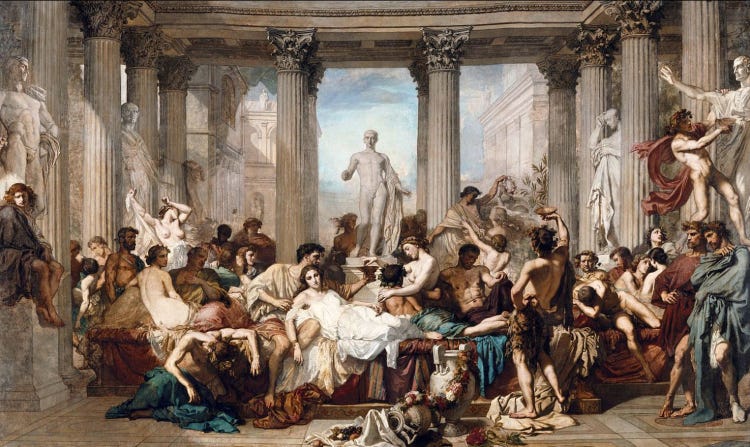
Thomas Couture, Les Romains de la décadence (decadent Romans) 1847, Musée d’Orsay, Paris.
Last weekend, the United States used military force in Venezuela, forcibly removing the country’s sitting president and transferring him to U.S. custody to face charges related to narco-terrorism and drug trafficking. The operation involved the extraterritorial use of force against a sovereign state and constituted a clear breach of multiple principles of international law.
The public justification offered by the United States did not engage with those legal violations. There was no attempt at rule-based argumentation. Instead, the act was reframed as fair and just: a necessary procedure to bring a dictator to justice where the law was said to have failed. President Donald Trump went even further, openly stating that the United States was now in control of Venezuela and its assets, including the country’s vast oil reserves.
Only weeks earlier, the European Union pursued a parallel course, seeking to confiscate Russian state assets held at Euroclear and redirect them to Ukraine. Sovereign assets are explicitly protected under both domestic and international law. Even the current practice of appropriating interest revenues already stretches those legal boundaries. Moving to confiscate the principal itself would cross them entirely.
Here too, the justification was not legal but moral. Because the EU deems Russia the aggressor in its war with Ukraine, seizing its assets to pay for damages in Ukraine would be fair and just: a righteous act in the absence of lawful authority.
In both cases, Western powers use moral language to legitimize why they are permitted to break international rules to which the rest of the world is expected to adhere. More troubling still is the fact that the Western international order itself established these rules after the Second World War precisely to constrain the abuse of power, protect state sovereignty and prevent exactly this kind of geopolitical aggression.
By invoking words such as fair and just instead of legal arguments, Western powers are not merely breaking the rules. They are hollowing out the framework that once distinguished authority from brute power. When the states that designed the post-war international order openly abandon its constraints and justify doing so through claims of moral superiority, they do more than undermine individual norms. They signal to the rest of the world that rules are conditional, international laws are optional and military power once again determines who’s boss. In doing so, they mark the end of Western civilization as it has existed since the Second World War.
The Original Meaning of Fair and Just
The phrase fair and just did not originate as a moral justification for immoral acts. Both terms describe outcomes that can exist only under clearly defined conditions.
Justice cannot be separated from law. It is neither a feeling nor an intention. Justice is the result of the correct application of a legal framework. It presupposes jurisdiction and established procedures. It also requires proportionality between act and response, and accountability of the authority enforcing the outcome. Whether an action or outcome is just cannot be asserted in advance; it can only be determined after the legal framework has been applied. In simpler words: there can be no justice without law.
By contrast, fairness concerns the conditions under which that outcome is reached. An action is fair only if the rules governing it are known in advance and applied equally to all parties. Those rules cannot be altered once the process has begun. Fairness offers no guarantee of a favorable result. It assesses only whether the process itself is impartial and stable.
Taken together, fair and just describe neither intent nor moral standing. They constrain the excess of power by subjecting it to a shared regulatory framework. An outcome can therefore only be fair and just if it is produced by rules that pre-exist the action, applied equally to all parties and binding the authority enforcing them.
This implies a crucial condition: acceptance of outcome. A system can only be called fair or just if its results are accepted even when they are unfavorable. Being constrained by rules that prevent a state from achieving its desired outcome is not an injustice. It is evidence that the system is functioning as intended.
Even when some powerful states have long acted in violation of these rules, the existence of a shared framework restrained power often enough to prevent escalation and large-scale conflict. The difference today is not that rules are being broken, but that their binding force is openly denied and replaced with moral claims.
Seen this way, fair and just were never tools of moral elevation. They were instruments of self-restraint. They transformed raw power into legitimate authority by making its exercise predictable, contestable and limited.
This is why in essence the rule-based international order functioned for decades. Until now.
How We Got from Illegitimate to Fair and Just
A visible turning point in the geopolitical inversion of fair and just was the 1999 NATO bombing of Kosovo during the Yugoslav war. NATO acted without a United Nations mandate and carried out a large-scale military campaign that resulted in significant civilian casualties. After the operation, the alliance openly acknowledged that the intervention had been illegal under international law, yet claimed it was legitimate.
That formulation mattered. By admitting illegality, NATO reaffirmed international law as the governing standard against which the intervention ought to be judged. Yet by framing the intervention as a tragic necessity required to end the war, the alliance avoided confronting the legal breach. At this point, international law was still treated as authoritative, even as it was overridden.
In the decade that followed, the Kosovo exception became standard practice. In Afghanistan after 2001, military intervention was framed not only as self-defense but as a just response necessary to protect civilians and restore order. When the legal justification based on weapons of mass destruction collapsed in Iraq in 2003, the intervention was reframed as enforcing justice, removing a tyrant and preventing future harm.
This pattern culminated in Libya in 2011. Acting under a narrowly defined UN mandate to protect civilians, NATO expanded the mission into regime change while continuing to describe the operation as fair, just and necessary. At this stage, fair and just no longer referred to compliance with a legal framework. They described how legal constraints could be stretched or reinterpreted. When that proved insufficient, they were exceeded.
After Libya, the practice of stretching legal mandates hardened into something more structural. In Syria, repeated U.S. and allied airstrikes were carried out without a UN mandate, but were justified as necessary and just responses to chemical weapons use and humanitarian suffering. In Yemen, Western powers continued military support and arms transfers to coalition forces despite mounting evidence of civilian harm, framing their role as fair and responsible engagement rather than as participation in an unlawful conflict.
In both cases, binding legal frameworks no longer functioned as the decisive source of legitimacy. Political declarations and informal coalitions took their place. Appeals to responsibility and values subsequently filled the gap. Just was used to legitimize the action itself, while fair served to normalize its conditions and consequences. Neither term was the result of any form of legal assessment but deployed to cover for the absence of one. In essence, the law was already sidelined, though not yet openly discarded.
That final step has now been reached. In Venezuela, the United States no longer attempted to place their actions within any recognizable legal framework. The extraterritorial use of force, the removal of a sitting head of state and the claim of control over national assets were first and foremost presented as fair and just for the United States itself: a legitimate assertion of power, interest and entitlement. Only in a second step were these actions framed as fair for the Venezuelan people, cast as liberation from a dictator and the restoration of freedom and order.
The EU has arrived at the same destination through financial rather than military means. In its attempt to confiscate Russian sovereign assets held at Euroclear, the EU openly acknowledged that existing legal frameworks offered no clear basis for such action. Instead of resolving that problem, it dismissed it. Because Russia was deemed the aggressor, confiscation was declared morally fair and just.
On both sides of the Atlantic, fair and just have now been fully detached from law and repurposed as its substitute. They no longer describe outcomes played by the rules, but function as axioms that authorize action by invocation alone. Anyone who questions such actions is accused of defending injustice or siding with evil, thereby neutralizing any form of legal debate. What remains is power exercised without constraint, responsibility or accountability; precisely the situation the rule-based order was designed to prevent.
The End of Western Civilization as We Know it
Trust comes on foot, but leaves on horseback. Within the Western hemisphere, actions such as the attack on Venezuela may be presented as decisive or even laudable: the removal of an untrustworthy dictator, order restored, justice served. Outside that echo chamber, the interpretation is very different.
What the rest of the world observes is not moral leadership, but a divided and declining West openly breaking the rules it once declared universal. It sees moral language used to sanctify the use of power. It sees that the rules imposed on others are optional for those who enforce them. It sees that fair and just no longer function as constraints, but as markers of rank with the West on top.
The result is a collapse of trust. A system that exempts itself from its own rules cannot be relied upon, negotiated with or bound by agreement. Once reciprocity disappears, legitimacy cannot survive. What remains is power asserted by moral superiority rather than grounded in law.
The global response to this shift is already visible and largely pragmatic. An increasing number of non-Western states no longer treat the West as a stable or reliable partner. Publicly, cooperation continues. Quietly, dependence is reduced and unwound wherever possible.
Over the past decade, countries within and around the BRICS framework have expanded direct trade relationships. They have developed parallel financial and payment systems and reduced reliance on Western-backed institutions and the petro-dollar. Western sanctions and military interventions intended to isolate individual states have only accelerated this process. When access to markets, reserves and security can be withdrawn unilaterally, dependence becomes a strategic risk. The more coercive these tools become, the stronger the incentive to build outside the Western framework.
In effect, the Western hemisphere is steadily losing both its customers and its access to the raw materials on which it depends. It enters this phase already burdened by high debt levels and a highly financialized and weakly productive economy. It is also structurally dependent on resources located outside the West and weighed down by extensive regulatory overhead. Under such conditions access, cooperation and trust are strategic necessities.
Rather than mitigating those vulnerabilities, current Western actions deepen them. By enforcing compliance through sanctions, confiscation and claims of moral superiority, the West has demonstrated that agreements, property, and even sovereignty are conditional upon them.
The response of the rest of the world will be economic and institutional rather than military. As trust continues to erode, non-Western countries will increasingly seek to reduce their exposure to Western systems that have proven conditional and discretionary. Trade relationships will be diversified, financial reserves placed outside Western-controlled frameworks and reliance on Western-backed institutions steadily reduced.
As access narrows and isolation deepens, the material foundations that sustained Western power begin to fail. A system dependent on external resources, global markets and continuous capital inflows cannot survive once those inputs are restricted. For decades, the Western standard of living has been maintained through debt rather than productive capacity. As trust erodes and access diminishes, that debt becomes unserviceable.
What follows is the breakdown of a system that can no longer sustain itself materially or financially. Military power may give a short reprieve, but cannot hold the structure together. The result is the end of Western civilization as we know it.
The future you fear is already here. Recognize the script before it writes you out.

Now, I'm convinced that Donald Trump as POTUS 47 (if not 45) is controlled opposition. Using the "fair and just" rationalization to supplant republican government (rule of law) with democracy (majority will) is bad enough when employed domestically (e.g. Congressional J6 "insurrection" prosecutions) but becomes exponentially worse when deployed as foreign policy.
While the Chavez/Maduro/Dominion/communist/narco takeover of Venezuela is demonstrably an atrocity and an injustice, the U.S. President has acted outside international law and the U.S. Constitution of his own authority. No "just cause" justifies (pun intended) a military incursion and abduction of a foreign sovereign head of state.
Cui bono from this abduction? I suspect the Federal Reserve and BlackRock.