
Without a Single Shot
Part 4 of the Indoctrination Series

Apologies for the two-month gap. Personal matters kept me from writing. Let's continue!
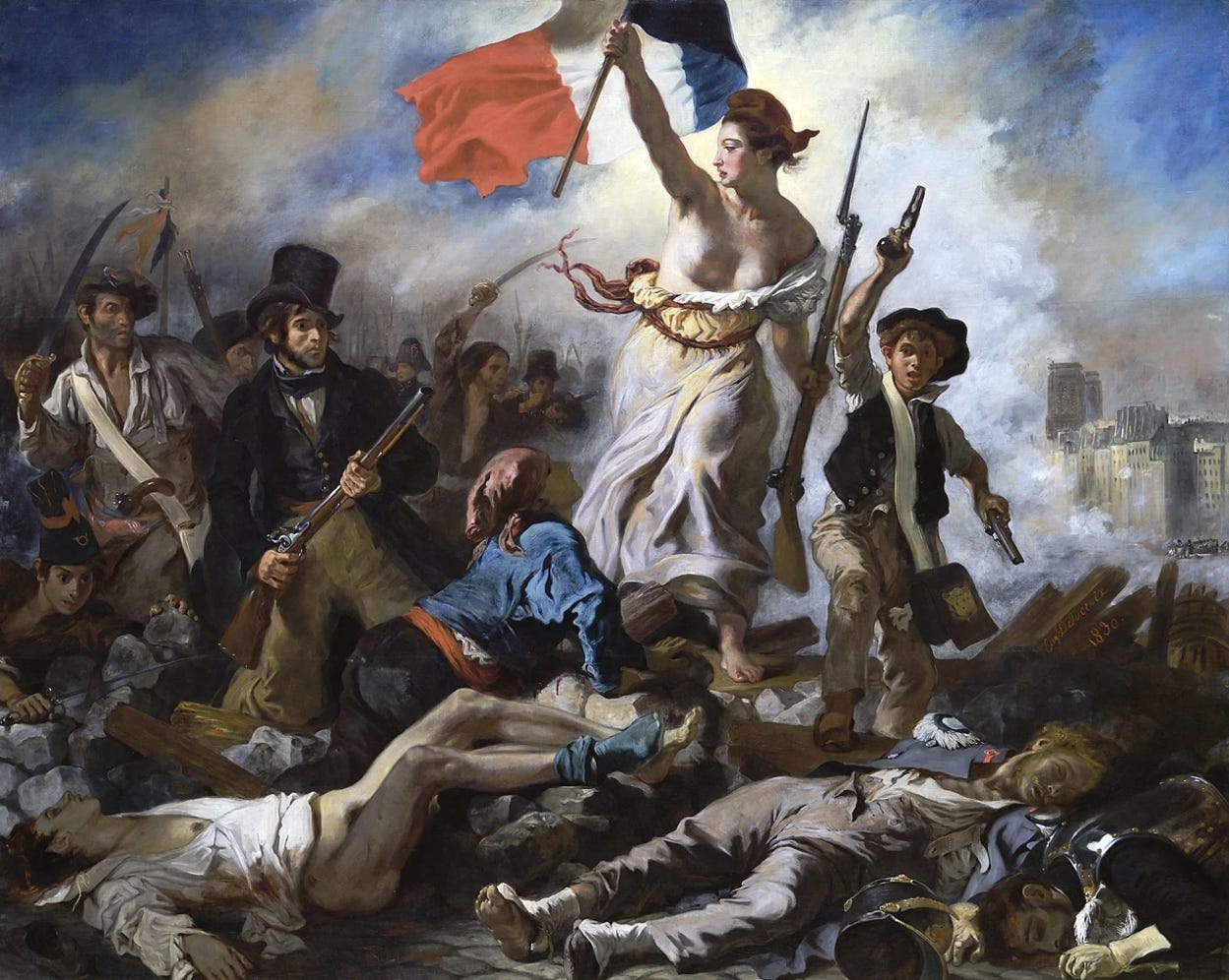
Eugène Delacroix, La Liberté guidant le peuple / Liberty Leading the People (1830), Musée du Louvre, Paris.
In the previous articles, we have covered a lot of ground already when it comes to indoctrination and demoralization. We started out with the indoctrinated individual: the one who tests you with questions, demands proof for everything you say and moves the goalposts when you get too close. Annoying but predictable and harmless the moment you recognize the script.
Then we moved on to the demoralized mind and things turned considerably darker. These are the people who have internalized the script and treat every critique as a personal attack. Their responses are almost always hostile and can turn dangerous. There is no middle ground when it comes to demoralization. Once critical thinking has shut down completely, the collapse tilts to fight or flight. Together they produce the perfect machinery of a society that starts policing itself.
Then came language. We traced how words are stripped of their original meaning, reloaded with moral weight and spread through activist networks into law and everyday life until no one recognizes the true meaning anymore. This is the moment when language itself creates fault lines that fracture Western society and facts become secondary to the moral weight assigned to words. As a result, people no longer disagree about interpretations of reality but start arguing about reality itself.
This is where we are now. The point where inverted language has been adopted by all the institutions and is spread as the new truth.
Let’s find out what happens next.
The Subverted Society
In 1984, Yuri Bezmenov gave an interview that has since been watched by millions. As a former KGB agent, he had defected to the West in 1970 and began warning about how the USSR used demoralization techniques to destabilize and ultimately dismantle its enemy societies from within. Bezmenov called it ideological subversion and he broke it down into four stages: demoralization, destabilization, crisis, and normalization.
Demoralization, he explained in his video, targets the foundations on which a society rests. Not its military or its economy, but its culture: religions, education, the social bonds between people, the legitimacy of government, the rule of law and the relationship between employers and their workforce. The goal of demoralization is to hollow out these institutions, for example by ridiculing religion, by providing children with textbooks telling them what to think and how to feel and by replacing community with state-funded bureaucratic institutions. Running through it all is the most powerful solvent of societies: the ideology of absolute equality, or equity as it is called today, hollowing out personal responsibility by replacing equal opportunity with equal outcomes.
Destabilization follows. When everybody thinks they are right or entitled, people are pitted against one another. Black versus white, poor versus rich, young versus old, the righteous versus anyone else. It is the moment when the demoralized society turns on itself and every relationship that once held society together becomes a battleground. As a result, differences that used to be resolved through conversation, now escalate into legal disputes or open confrontation.
When a society becomes so fragmented that nothing can be solved anymore and every disagreement becomes a battle for moral supremacy, crisis follows. Legitimate power structures lose their authority and are replaced by unelected organizations, self-appointed experts and activist groups. Media outlets appoint themselves as the arbiters of truth by spreading narratives that coincide with their beliefs, while repressing everything that contradicts them. The population, divided and suppressed, starts looking for a strongman to restore order. Of course, that strongman always steps forward, but on both sides of the divide. At the end of this stage, only two outcomes are left: civil war or a power grab that imposes stability by force.
Normalization follows when the new power is in place and obedience is demanded. The very people who drove the subversion are now a liability and are cancelled or eliminated. One narrative replaces all others and the society that existed before is simply gone.
Bezmenov recorded his video in 1984 when the USSR was still a formidable power, and passed away shortly after. His model rests on one key assumption: that subversion is driven by an external enemy. But that enemy, the USSR, collapsed in 1991 and ceased to exist. Yet many western countries are in crisis today, precisely as Bezmenov predicted. The following tragic events illustrate how his model found its proof.
Between 1997 and 2013, an estimated 1,400 girls, most of them white and from care homes, were systematically raped and trafficked in Rotherham. The police, social workers and local politicians all knew, but for over a decade nobody acted. Later investigations revealed that officers looked away because they were afraid of being called racist. In the meantime, young girls were arrested for being drunk and disorderly while their abusers walked free. Fathers who tried to retrieve their daughters were detained by the police. A girl was found in a derelict house with multiple male abusers, leading to her arrest, not of the abusing men. The Casey Report of June 2025 confirmed that data on the ethnicity of perpetrators had been systematically avoided for years; it was a culture of blindness, ignorance, prejudice, defensiveness, and even good but misdirected intentions.
In contrast to the Bezmenov model, there was no foreign power behind this massive scandal. Government institutions had simply learned to place the risk of being called racist above the protection of children. In other words, we are being destroyed from within. But then the question is: what is driving it?
The Folly of Luxury Beliefs
The road to hell is paved with good intentions.
Over the last decades, the most profound damage done to Western societies comes from people who mean well and who devote their lives to making the world more virtuous, more equal and more just. Yet their measures consistently produce the opposite result, driven by beliefs about how the world should work rather than how it actually does. And because the people who design these policies rarely live with the consequences, there is nobody to tell them they are wrong.
The term luxury beliefs was first defined by writer Rob Henderson, who observed that the upper classes had replaced status symbols with status convictions: ideas that are costless to hold at the top but carry real consequences for everyone below. In an earlier article I expanded on this definition, to capture what happens when luxury beliefs are converted to government policy:
Luxury beliefs are ideas grounded in good intentions and noble motives, but when implemented as policy, they often result in disastrous outcomes.
As such, luxury beliefs share five characteristics:
They are rooted in intentions: Luxury beliefs are based more on good intentions, assumptions, calculation models, and fallacies, rather than on solid, underlying facts.
They are detached from consequences: Individuals who uphold luxury beliefs often do not experience the negative consequences of the policies derived from these beliefs.
They are absolute: Luxury beliefs are frequently oversimplified to the extent that any nuance or alternative interpretations are disregarded. Consequently, well-founded criticism is almost impossible to acknowledge.
They cost a lot to implement with very low results: Luxury beliefs often demand significant financial resources without yielding measurable results.
They are a solely Western phenomenon: Luxury beliefs cease to exist when you cross the border.
Luxury beliefs are generally held by people who live insulated. They do not live in the neighborhoods their immigration policies affect. They do not sit in the classrooms their education reforms produce. They do not pay the energy bills their climate targets generate. As such, they see not reality as it is, but an idealized version of what ought to be.
It started in the 1960s, when a generation of students who rejected the established order went into academia. They went on to become the professors, scientists, sociologists, educators and historians who have been teaching our children ever since. The spread accelerated in the 1990s when Western universities expanded massively and a university degree became the gateway to institutional power. Graduates then flowed into functions where they could actively practice the worldviews they learned in college: government and politics, education, media and NGOs.
With enough people holding luxury beliefs in high places, the mechanism became self-enforcing. Hiring committees selected people with the same beliefs, creating a homogeneous class that now controls the institutions shaping public life. Inside that world, evidence that contradicts the belief is simply dismissed. The policy can therefore never be wrong: it is the people living with the consequences that have simply not understood it correctly, or have not made the right choices.
One of the clearest examples of luxury beliefs is the folly of genderism. Starting from a genuine concern that transgender people deserved better legal protection, Western institutions began replacing the biological category of sex with the self-declared category of gender identity. The intentions were good. The consequences were not.
Men who identified as women gained access to female prisons, changing rooms and domestic violence shelters. Male-born athletes began competing in women’s sports, breaking records and displacing female competitors. Women who objected were called transphobic. The luxury belief that gender identity must always override biological sex was absolute and it was absolutely non-negotiable.
But the biggest victims were the children. The same institutional machinery that had pushed gender identity into law moved into education. Children were taught that biological sex was a social construct and that they could be any gender they felt. What they were taught came straight from academia, where a multitude of studies citing one another had stripped gender from biology. In reality, these studies all drew from the same small dataset, provided by an even smaller network of clinics and researchers. Using the same data and the same methodology, they inevitably reached the same conclusions. Even so, the copied findings were reported as scientific evidence.
Those who objected publicly were destroyed. J.K. Rowling became the most prominent target: years of coordinated harassment, death threats and professional boycotts followed her public statement that biological sex is real. Academics, doctors, journalists and ordinary people who asked questions about the evidence or the safeguarding of minors were labelled transphobic, fired or deplatformed. Meanwhile, from the mid-2010s onward the number of adolescents referred to gender clinics increased tenfold, overwhelmingly girls. Thousands of minors started receiving puberty blockers, cross-sex hormones and gender reassignment surgery on the promise it was all safe, reversible and life-saving. When the evidence-base finally collapsed under independent scrutiny, thousands had already undergone irreversible procedures.
By then, the activists who had driven the gender agenda had moved on to the next moral emergency. After October 7, 2023, the same networks pivoted almost overnight to the pro-Palestinian cause. "Queers for Palestine" became the emblem of that shift: gay and transgender activists marching in solidarity with a movement that executes people for the same identity they march for.
The Consensus Machine
At the root of Western democracy stands the trias politica: a separation of powers between the legislature, the executive and the judiciary. Together they represent a system of checks and balances, where each independent power limits the other two. Yet when these three powers start to move in the same direction, democracy ceases to exist but in name only.
In the last three decades, Western institutions have become almost entirely progressive. The three powers now share the same mindset, the same luxury beliefs and the same moral language. As a result, they no longer correct each other, but reinforce each other in pursuit of the same objectives.
The engine behind this reinforcement is the non-governmental organization (NGO). For most of the twentieth century, NGOs were primarily associated with humanitarian aid. However, from the 1990s onward, governments started using the NGO to meet objectives for which they could not attain democratic support. NGOs became political and started presenting themselves as working in the public interest, while lacking the public mandate and accountability to do so.
To understand the game, one must follow the money. Governments fund NGOs whose objectives align with their own political agenda. Those NGOs lobby the legislature, provide expert testimony and take the policy objective to court when democratic support falls short. The judiciary, shaped by the same institutions and carrying the same luxury beliefs, rules in their favor and orders governments to implement and execute laws they could not pass through democratic means.
The European Green Deal is a clear example of how this works in practice. The European Commission is the author of Europe's largest environmental legislation. To get it passed, the EC channeled billions through its LIFE environmental subsidy program. The contracts were explicit: NGOs had to prove their lobbying had made Green Deal legislation more ambitious, actively promote the Nature Restoration Law, which faced the most resistance, and steer agricultural debates in a greener direction. The NGOs then went to work on the Members of the European Parliament who opposed the Green Deal, flipping their votes against the explicit wishes of their own constituents. And it worked. Despite fierce opposition the Green Deal passed and was subsequently presented as the will of the people.
The media closes the loop. Journalists come from the same universities and enter the newsroom carrying the same luxury beliefs as the politicians and judges they are supposed to hold to account. Furthermore, the outlets they work for are owned by a handful of conglomerates whose owners move in the same circles, sit at the same tables and share the same worldview. As a result, the news produced by these outlets is selective, amplifying what confirms the consensus and downplaying or ignoring what challenges it.
Together, politicians, judges, NGOs and media create a self-sustaining sealed system. The legislature produces the policy. The executive funds the advocacy. The NGO lobbies the legislature and takes the legal route when lobbying is not enough. The court validates the outcome and the media subsequently explains why it was necessary.
Each part of the system believes it is acting independently. None of them are.
One only has to point at the handling of COVID-19 to see how dangerous the consensus machine can become. From early 2020 onward, governments, courts, scientific institutions and media operated in near-perfect alignment. Lockdowns were imposed with court approval. Vaccine passports tied access to public life to vaccination, while doctors who prescribed alternative treatments were prosecuted and fined. Scientific institutions suppressed findings that challenged the narrative. Media outlets that should have been asking questions were instead enforcing the consensus. And social media platforms removed content and deplatformed professionals on government instruction. None of this required coordination. It only required a shared, unquestioned belief that the narrative was true and that deviation was a threat. Years later, with mounting evidence of the damage done, the consensus machine does not adjust. Mandates have been quietly dropped, but the excess mortality that started after massive vaccination with unknown mRNA is still being ignored. That is what makes the consensus machine genuinely dangerous. A dictatorship knows it is lying; the consensus machine does not. But the result is exactly the same.
Why Consensus Ultimately Leads to Dehumanization
A sealed system that is convinced its consensus reflects truth is always threatened by those who believe otherwise. In order to survive, it must therefore silence dissent. We have seen what that looks like on an individual level: the demoralized mind that labels, excludes and ultimately condones violence against anyone who challenges its narrative. But when the entire society applies that same logic in unison, something far more dangerous emerges. The brake is gone and history has numerous examples to show us exactly where that leads.
On the path to dehumanization a demoralized society follows the exact same steps as the demoralized person, only on a grander scale. It starts with the label. Your opinion is not a well-meant critique, but an extremist or dangerous point of view. You are categorized as a fascist, a threat to democracy or a danger to public health. At its core lies the same worst-motive fallacy as we discussed in the previous article of this series: the reflex to assign the worst motive behind any behavior we don’t like. By labelling the person, we no longer have to engage their arguments. Bad people can of course never be right.
The second step is exclusion. You don’t negotiate with a threat and you certainly don’t provide a platform to a danger. On a societal level, that exclusion is almost always institutional: a bank that closes your accounts, platforms that remove you completely, or governments that deny you access to their countries because your opinion might incite division. Institutional exclusion is far more effective than a mob cancellation, because the institution that excludes you is the same institution that rules on your objection. You simply disappear, while the system that erased you continues to present itself as fair and the guardian of free expression.
The final stage is dehumanization. By this point, the hatred is real and widespread, often with an intensity normally reserved for someone who has personally wronged them, even though most have never even met the person they hate. The actual person has been replaced by a symbol of evil and evil must of course be destroyed, without remorse and without the moral hesitation that the destruction of a human being would normally provoke. It is at this stage that elimination becomes justified; of a person, of a people, of a nation. Every mass atrocity has been preceded by dehumanization, where people could no longer see through the label and justified the violence accordingly.
For years, Putin has been the devil you don’t negotiate with. That label alone has been enough to frustrate peace negotiations, close the door to diplomacy and sustain a war at enormous human and economic cost. No serious attempt has ever been made to understand what drove the conflict, because understanding evil is already a form of collaboration. The narrative is simple: we are good, Putin is evil and every means is justified.
It is precisely this label that prevents us from ending the war. Diplomacy requires us to see the human being on the other side of the conflict, but dehumanization prevents us from doing just that. The result is a war that keeps grinding because stopping it feels like moral surrender and letting the devil win. In the meantime, our moral crusade has had the opposite effect: sanctions meant to cripple Russia’s economy have instead crippled our own and the window for peace negotiations has long since closed.
The same mechanism played out in the medical world during COVID. Doctors and scientists who questioned the official protocol were labelled dangers to public health and spreaders of disinformation. Their findings were suppressed, their licenses revoked and their voices removed from the public debate. The institutions that were supposed to protect the integrity of medicine became the enforcers of the narrative instead. To this day, doctors are being prosecuted, fined and disciplined by health inspectorates and professional associations for having the audacity to deviate from the official narrative. It is a tragic example of how a society that immunized itself against correction ultimately turned the cure into something worse than the disease.
But even on the individual level, a demoralized society demands your absolute obedience. A social media post with ‘the wrong opinion’ is nowadays enough to label you a racist, conspiracy theorist or a climate denier. Execution follows swiftly in the form of shadow banning, algorithmic suppression and deplatforming, with no room for appeal. The European Union has built its own censorship complex with the Digital Services Act, which requires social media platforms to remove all content deemed illegal or harmful. In the United States, freedom of speech is secured in the first amendment, but that doesn’t deter institutions like the FBI or CIA from opening investigations when your opinion threatens that of the establishment.
From a world leader to a doctor to an ordinary citizen posting the wrong opinion, the mechanism is always the same: label, exclusion, punishment. A society that has fully internalized this mechanism has transferred control over reality itself. It’s not just silencing dissenting voices, it is silencing facts and replacing them with narratives. When the line between illegal and critical is drawn by the same institutions that benefit from the outcome, they do not only censor reality.
They decide what reality is.
In the next article we move on to what happens when reality becomes a forged concept and why the West is just as capable of propaganda and foreign interference as any non-western nation.
This Substack is free and stays that way. But facts don't surface themselves. If you value this work, consider a voluntary contribution.

The future you fear is already here. Recognize the script before it writes you out.

Geweldig goed artikel. Legt feilloos bloot dat we op weg zijn naar de definitieve ondergang van de democratie. Of dit nog te voorkomen zal zijn, betwijfel ik ten zeerste. Onheilspellend. Je word er moedeloos van.